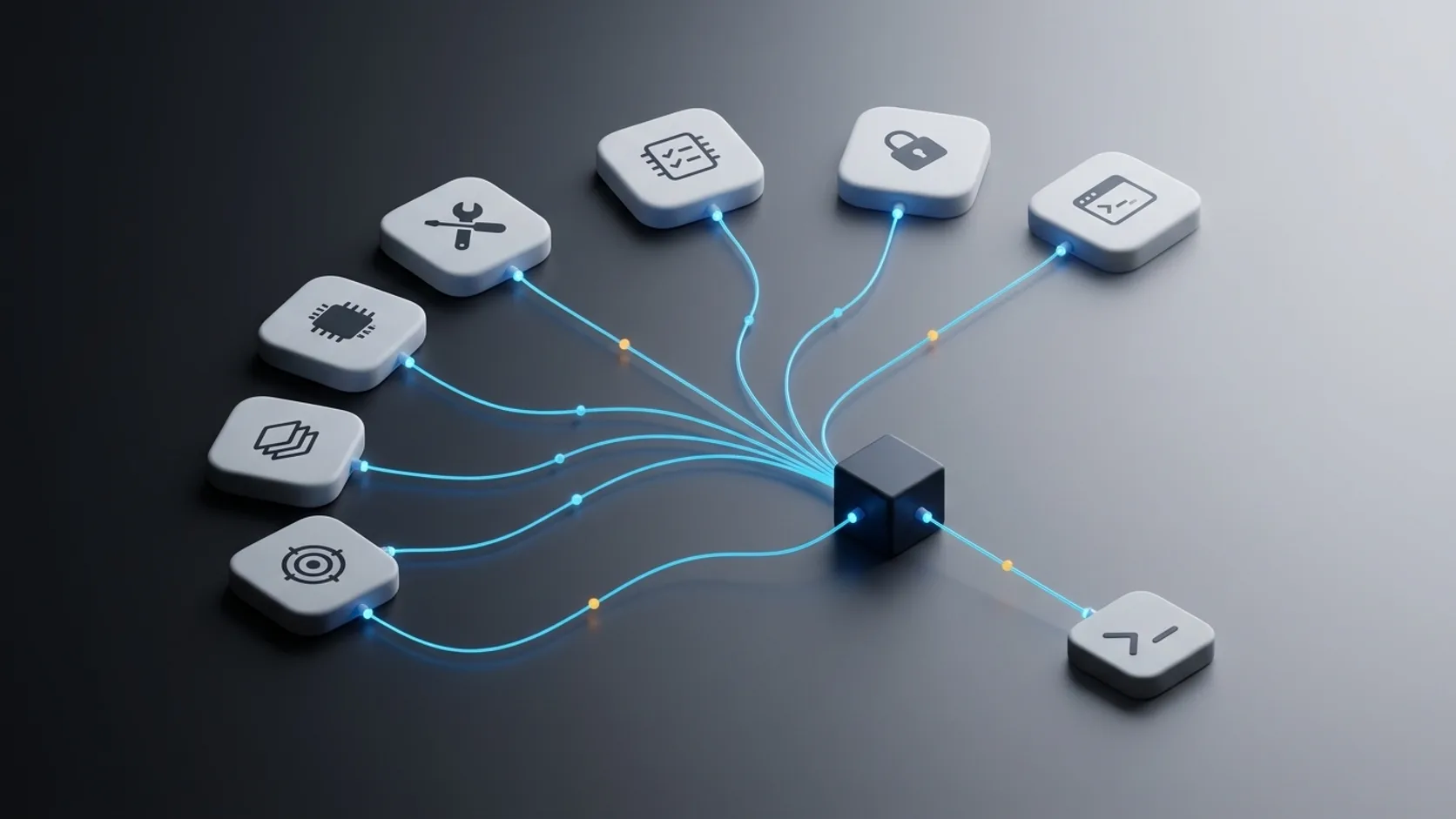
The mental architecture of an agent: 7 questions before the first prompt
In the previous post I argued for a simple distinction: a chatbot talks, an agent executes. What was missing is the practical part. If an agent is an execution system, how do you design that system before writing the first line of prompt?
Here is the short answer: the prompt is the last thing.
The most common mistake I see is starting with the prompt. Someone opens the editor, writes "you are an assistant specialized in...", and starts testing. The demo even works. But what they built is not an agent — it is a chatbot with hope.
Seven architecture decisions come before the prompt. I think of them as seven questions. If you cannot answer all seven, you do not have an agent to build yet. You have an idea.
1. Goal — what has to be completed?
The first question sounds obvious and is almost never answered properly. "Answering well" is not a goal. "Helping the user" is not a goal. A goal is a termination condition you can verify.
Compare:
- Bad: "handle the customer in support".
- Good: "resolve or escalate the ticket, leaving a record with the reason".
The second one has an ending. The first runs forever. An agent without a verifiable termination condition is an agent that never knows it is done — and then it either stops too early or keeps spinning.
2. Context — what does the agent know right now?
A model does not get context by osmosis. Everything it "knows" at that step is either in the window or was fetched by a tool. Designing context means deciding what goes in directly and what the agent will fetch on demand.
The common mistake here is the opposite of what it looks like: it is not missing context, it is too much. People dump the entire manual, the entire history, and three documents into the prompt "just in case". The result is expensive, slow, and more confusing — the model loses track of what is relevant.
3. Tools — what can it do outside the model?
A model on its own predicts text. What turns an answer into execution is the ability to use tools: an API, a database, a queue, a webhook.
This question deserves a post of its own — it is the next one in the series. For now, what matters at the architecture stage is deciding which tools exist and, more importantly, which ones do not. An agent with too many tools is a confused operator with too much access. Fewer tools, better defined, almost always wins.
4. Memory — what has to be remembered between steps?
Memory becomes a magic word and loses its meaning. I split it in two:
- Task memory: what the agent has to carry between the steps of a single run (the order it is processing right now).
- Cross-task memory: what has to survive from one run to the next (preferences, what has already been tried).
The mistake is confusing memory with an infinite conversation history. Storing everything is not having memory — it is having a cost and noise problem. Good memory is selective and has a purpose.
5. Criteria — how do you know it was done well?
If you do not define quality up front, you will define it later, in a panic, when a customer complains. I evaluate agents on four axes:
| Axis | The question |
|---|---|
| Outcome | was the task completed correctly? |
| Path | did it choose the appropriate tools? |
| Safety | did it respect limits and permissions? |
| Cost | was it worth the price in tokens, time, and infra? |
Notice that "outcome" is only one of the four. An agent can get the right answer by the wrong path, spending ten times more, touching a system it should not have. That is not success — it is luck that has not run out yet.
6. Limits — what can it not do on its own?
This is where the risk almost nobody puts on day one lives. Everyone thinks about hallucination. In a system that acts, the more operational risk is a different one: permission without control.
I split actions into three levels:
| Level | Example | Behavior |
|---|---|---|
| Read | query, list, fetch history | runs directly |
| Preparation | generate a proposal, simulate, draft a reply | prepares, does not commit |
| Write | change, send, charge, cancel | hard rule or a human |
Defining limits means deciding, for each tool, which level it falls into and where a confirmation point goes. Full autonomy on day one is not ambition — it is a lack of design.
7. Logs — how do you audit what happened?
The last question is the one most people skip: how do I find out what the agent did when something goes wrong? And it will.
An agent log is not console.log. It is a record of decisions: which tools were
called, with which arguments, what the model got back, which path it chose, and
where it failed. Without that, the first one to tell you the agent got it wrong
will be the customer — and you will not be able to explain why.
Logs are part of the product, not an extra you bolt on later.
The prompt comes last
Once the seven questions are answered, something funny happens: the prompt almost writes itself. It becomes just the wording that ties together what you already decided — the goal, the available context, the tools, the limits.
The prompt is the interface between your decisions and the model. If the decisions are good, a simple prompt does the job. If the decisions do not exist, no prompt saves you.
Answering the seven on paper costs an afternoon. Finding out they were missing, in production, costs an incident.
Continue the series
Question 3 is Tools as contracts: how to design a tool the agent will not misuse.
Related posts
A chatbot is not an agent: the difference that actually matters
The practical difference between chatbots and AI agents, and why that distinction changes architecture, product, risk, and operations.
Tools as contracts: designing tools the agent won't misuse
An agent doesn't call your API because it read the code — it reads the description and decides. That's why every tool is a contract: what it does, inputs, outputs, errors, whether it's reversible, and whether it needs approval.

A pentester read another customer's conversation — and I learned where the boundary lives
Two months after launch we hired an ethical hacker. He found two critical flaws. The worst was a conversation ID exposed in the front-end that gave access to another customer's data. The lesson is not about IDOR.