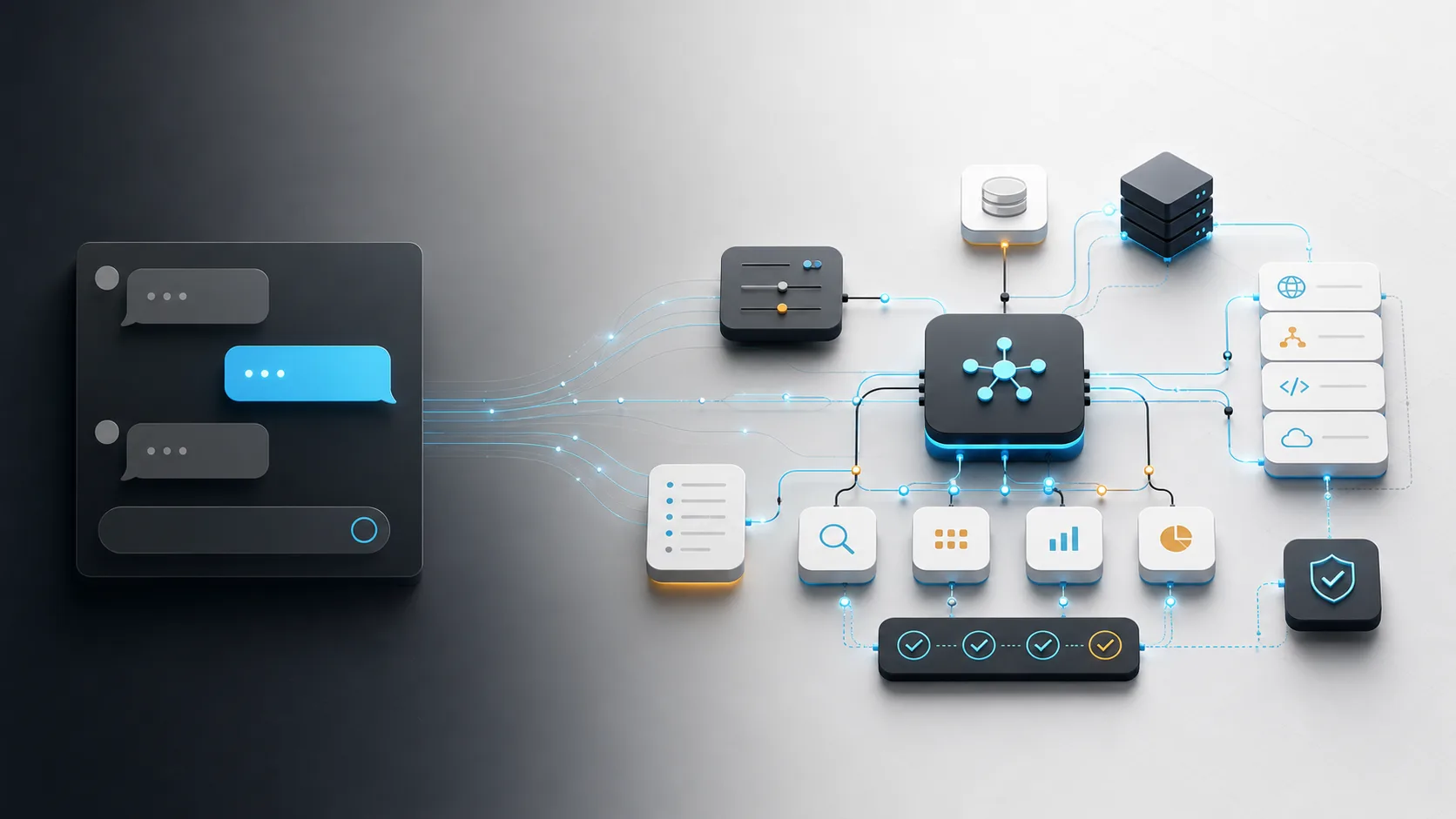
A chatbot is not an agent: the difference that actually matters
Over the past few months, almost anything involving AI started being called an agent. A chatbot with a better prompt became an agent. A flow with three API calls became an agent. An assistant that answers questions became an agent.
I find this confusion dangerous because it gets in the way of the technical decision. If everything is an agent, then nothing is an agent. And when the word loses precision, the architecture loses it too.
A chatbot talks. An agent executes.
That is the simplest difference, but it opens up several others: goal, tools, memory, permissions, validation, logs, cost, risk, and how you measure quality.
A chatbot is an interface
A chatbot is, first of all, a conversational interface. It receives a message, interprets whatever context is available, and returns an answer.
That can be extremely useful. A good chatbot helps with support, answers common questions, queries a knowledge base, summarizes documents, and reduces friction for the user.
But in most cases it is not responsible for completing a job from start to finish. It guides, answers, suggests, or hands off.
The limit shows up when the conversation has to become execution.
For example:
- look up a customer in the database;
- check business rules;
- generate a proposal;
- request approval;
- record a change;
- send a message;
- follow up on the result;
- correct course if something fails.
Once the system starts taking actions using external tools, the conversation stops being the center. Execution becomes the center.
An agent is an execution system
An AI agent is not just a model answering better. It is a system that uses a model as one part of a chain of decision and action.
An agent usually needs a few elements:
| Element | The question it answers |
|---|---|
| Goal | What has to be completed? |
| Context | What does the agent know right now? |
| Tools | What can the agent do outside the model? |
| Memory | What has to be remembered between steps? |
| Criteria | How do you know the task was done well? |
| Limits | What can it not do on its own? |
| Logs | How do you audit what happened? |
Without those elements, we are usually not talking about an agent. We are talking about a chatbot, a workflow, an automation, or an integration with AI.
And that is not a problem. The problem is picking the wrong architecture because the name sounds more modern.
The right question is not "does it have AI?"
A better question is: which part of the work requires judgment?
If the process is predictable, with clear rules and few exceptions, a workflow probably solves it. It could be code, N8N, a queue, a scheduled job, or a direct integration between systems.
If the process requires interpreting natural language, dealing with ambiguity, choosing between possible paths, and reaching for different tools depending on the case, then an agent starts to make sense.
Simple example: answering "what's the status of my order?" can be a chatbot with a database lookup.
Now picture a different scenario: "my order is late, I need to change the address, but I can only receive it after 6pm".
In that case the system may need to:
- identify the right order;
- check delivery rules;
- verify whether the address change is still possible;
- evaluate the delivery window;
- propose alternatives;
- ask for confirmation;
- record the change;
- notify another system;
- explain the decision to the user.
That is the kind of situation where the architecture starts to look like an agent.
The agent needs tools
A model on its own does not do much. It predicts text.
What turns an answer into execution is the ability to use tools: APIs, databases, queues, internal systems, spreadsheets, webhooks, automations, and external services.
This shifts the responsibility of the project. Writing a nice prompt is not enough. You have to design which tools exist, what inputs they accept, what permissions the agent holds, and which actions require human confirmation.
I like to think of tools as contracts. Each tool has to make clear:
- what it does;
- what data it receives;
- what data it returns;
- what errors can happen;
- whether the action is reversible;
- whether it needs approval before running.
An agent with poorly defined tools becomes a confused operator with too much access.
The biggest risk is too much permission
When people talk about AI, they usually think of hallucination first. That is a real risk, but in agentic systems there is another one that is even more operational: permission without control.
A chatbot that answers wrong produces a bad answer. An agent with too much permission can change data, send messages, trigger charges, cancel orders, or run actions in real systems.
That is why I split actions into three levels:
| Level | Example | Expected behavior |
|---|---|---|
| Read | look up an order, fetch history, list options | can run directly |
| Preparation | generate a proposal, draft a reply, simulate a change | can prepare, but not finalize |
| Write | change a record, send a message, charge, cancel | requires a hard rule or approval |
This separation keeps you from treating every tool as if it carried the same risk.
An agent without evaluation is a demo
A common mistake is testing an agent only with nice examples.
The demo works. The recording looks good. The first conversation is impressive. But the real product shows up in the bad cases: incomplete data, ambiguous requests, annoyed users, APIs that are down, conflicting answers, and business rules nobody documented.
To take an agent seriously, I need to evaluate at least four things:
- outcome: was the task completed correctly?
- path: did the agent choose appropriate tools?
- safety: did it respect limits and permissions?
- cost: was the run worth the price in tokens, time, and infrastructure?
Without that, the agent may look smart, but it is not reliable.
Logs are part of the product too. You cannot operate an agent in production without knowing which tools were called, what responses the model received, what decisions it made, and where it failed.
When I would not use an agent
I would not use an agent when the process is simple, repetitive, and fully deterministic.
I would also avoid an agent when the company does not yet understand its own process. If nobody can explain the rule by hand, putting AI in the middle usually just automates the confusion.
Another delicate case is when the action has high impact and low tolerance for error: finance, legal, health, sensitive cancellations, or irreversible changes. Agents can take part in those flows, but they should rarely start with full autonomy.
In those scenarios I prefer to start with:
- a traditional automation;
- an assistant that prepares decisions;
- an internal copilot;
- a flow with human approval;
- detailed logs before releasing direct action.
Where Hermes and OpenClaw come in
Tools like Hermes and OpenClaw enter this conversation as practical labs for getting out of theory.
But I do not want to start the series with the tool. I want to start with the criterion. Before asking "how do I use Hermes?" or "how do I use OpenClaw?", the question that matters is:
what kind of work do I want an agent to carry out, with which tools, and under what limits?
After that, the tool becomes a consequence.
In the next posts I want to explore agents along that path: first the mental architecture, then the implementation, then operating them in real scenarios.
The distinction changes the product
When a system is only a chatbot, the main experience is having a conversation.
When the system is an agent, the main experience is delegating work.
That shift sounds small, but it changes everything:
- the user expects progress, not just an answer;
- the system has to know when to stop;
- the interface has to show state;
- the backend has to record decisions;
- the product has to handle failures;
- the team has to measure execution quality.
That is why I think it matters to keep the terms separate.
A chatbot is a powerful interface.
An agent is an execution architecture.
One can use the other, but they are not the same thing.
And the sooner that difference is clear, the better the decision about what to build.
Related posts
The mental architecture of an agent: 7 questions before the first prompt
Before you write a single prompt, an agent demands 7 design decisions — the same 7 that separate a reliable agent from a good-looking demo.
Tools as contracts: designing tools the agent won't misuse
An agent doesn't call your API because it read the code — it reads the description and decides. That's why every tool is a contract: what it does, inputs, outputs, errors, whether it's reversible, and whether it needs approval.

A pentester read another customer's conversation — and I learned where the boundary lives
Two months after launch we hired an ethical hacker. He found two critical flaws. The worst was a conversation ID exposed in the front-end that gave access to another customer's data. The lesson is not about IDOR.